
Overview
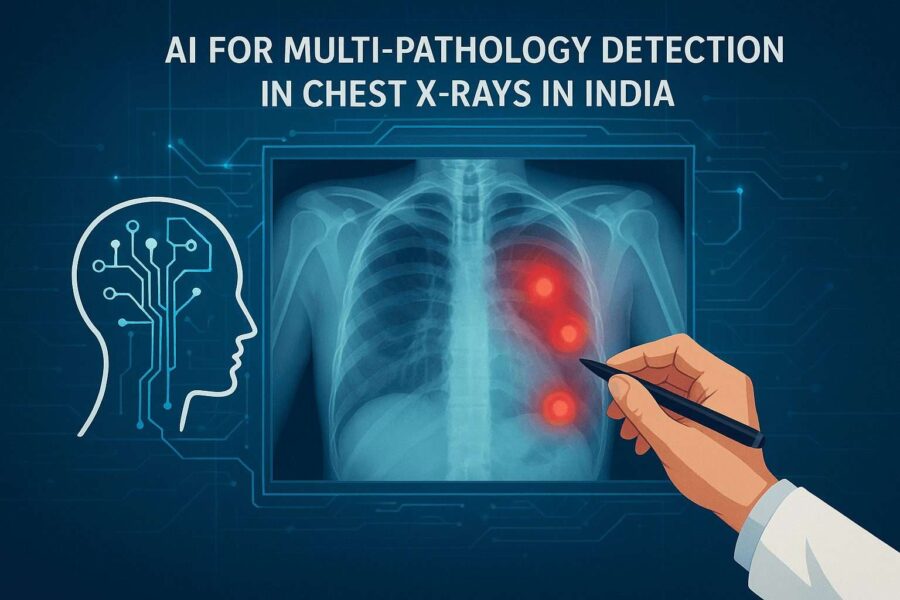
Artificial Intelligence (AI) is transforming healthcare worldwide, and India is no exception. In particular, AI for multi-pathology detection in chest X-rays in India is gaining attention because it can support doctors in detecting a wide range of diseases such as tuberculosis, pneumonia, lung cancer, and chronic obstructive pulmonary disease. Since India faces a huge burden of respiratory diseases, the integration of AI into radiology can create a remarkable change in healthcare delivery.
In addition, with the rising demand for faster and more accurate diagnoses, AI is being developed as a supportive tool to help radiologists and physicians make better decisions. Therefore, the role of AI in multi-pathology detection in chest X-rays in India is not only promising but also necessary.
The Growing Burden of Chest Diseases in India
First of all, it is important to understand why chest X-rays are so critical in India. Chest-related diseases such as tuberculosis, pneumonia, and lung cancer are among the leading causes of mortality. Moreover, India is home to the highest number of tuberculosis patients in the world, making early and accurate detection an urgent requirement.
Furthermore, millions of chest X-rays are performed every year, and yet the shortage of trained radiologists continues to be a challenge. As a result, many patients in rural areas do not get timely diagnoses. Because of this, the idea of AI for multi-pathology detection in chest X-rays in India has emerged as a game-changing solution.
How AI Helps in Multi-Pathology Detection
AI works by using deep learning algorithms trained on thousands of chest X-ray images. As a result, it learns to identify patterns and abnormalities that may indicate diseases.
For example:
- It can detect pneumonia by identifying cloudiness in lung fields.
- It can detect tuberculosis by spotting specific lesions in the lungs.
- It can highlight nodules that may suggest lung cancer.
- It can assess chronic obstructive pulmonary disease (COPD) by analyzing airflow blockages.
Therefore, AI systems do not replace radiologists but rather act as assistants. By doing so, they reduce diagnostic errors, speed up reporting, and support early detection of multiple diseases simultaneously.
Why AI is Crucial in India
In India, healthcare challenges are unique. First, the patient population is huge, and the number of doctors is limited. Second, rural healthcare centers often lack advanced diagnostic facilities. Third, patients from low-income groups cannot afford repeated or delayed testing.
Because of these issues, AI for multi-pathology detection in chest X-rays in India becomes extremely valuable. Since AI can analyze images instantly, it helps reduce waiting times and ensures that even in remote areas, doctors can provide accurate care. In addition, AI systems can be integrated into telemedicine platforms, which further expands their reach.
Benefits of AI for Multi-Pathology Detection
There are several advantages of using AI in this field:
- Faster Diagnosis – AI can interpret chest X-rays in seconds, which reduces delays.
- Higher Accuracy – AI improves precision by reducing human errors.
- Scalability – AI can handle thousands of X-rays daily, which is critical in India.
- Support for Rural Healthcare – AI enables access to diagnostic support in remote areas.
- Cost-Effectiveness – Early detection saves costs by reducing the need for advanced treatments.
- Assistive Role – AI supports radiologists rather than replacing them, making their work more efficient.
Therefore, the adoption of AI for multi-pathology detection in chest X-rays in India is not only a technological improvement but also a social necessity.
Challenges in Implementation
Although AI has great potential, there are challenges:
- Data Quality – AI needs high-quality datasets of chest X-rays, which are sometimes unavailable in India.
- Infrastructure – Many hospitals still lack digital X-ray machines and storage facilities.
- Regulation – AI tools must be approved by medical authorities before use.
- Awareness – Doctors and patients need to be educated about the role of AI.
- Cost Barriers – Although AI reduces long-term costs, the initial investment can be high.
However, with the government and private sector working together, these barriers can be overcome.
Current Developments in India
In India, several research groups, startups, and healthcare providers are working on AI for multi-pathology detection in chest X-rays. For instance, some AI models are being trained using data from public hospitals. Furthermore, collaborations with global health organizations are helping India develop low-cost AI tools.
Additionally, the government has launched digital health missions, which can integrate AI solutions into hospitals and diagnostic centers. As a result, the adoption of AI in chest X-ray diagnosis is steadily increasing.
Future of AI in Chest X-Ray Diagnosis
The future looks very promising. In the coming years, AI will likely become a standard part of radiology departments across India. Furthermore, with the help of cloud-based platforms, rural clinics will be able to upload X-rays and receive AI-assisted reports instantly.
Moreover, AI will not only detect diseases but also predict risks based on patient history. Therefore, preventive care will improve, and lives will be saved. In addition, as AI systems become more advanced, they will integrate with other medical imaging technologies such as CT scans and MRIs.
Role of Radiologists with AI
Some people fear that AI will replace radiologists. However, the truth is different. In reality, radiologists will continue to play an essential role because AI only highlights possible problems. Afterward, the radiologist interprets the findings in the context of the patient’s condition.
Therefore, instead of replacing doctors, AI enhances their ability to make better decisions. As a result, radiologists in India will be able to focus more on complex cases while AI handles routine screening.
Ethical and Legal Considerations
Since AI involves patient data, ethical issues must be considered. For example, data privacy must be ensured, and patients should know how their X-rays are used for training AI. Furthermore, AI systems must be transparent, so that doctors understand how a decision is made.
Additionally, legal frameworks must be developed to regulate AI use in hospitals. Therefore, India must balance innovation with safety to ensure AI is trustworthy.
FAQs
1. What is multi-pathology detection in chest X-rays?
Multi-pathology detection means identifying more than one disease in a single chest X-ray. AI can detect tuberculosis, pneumonia, lung cancer, and more at the same time.
2. Why is AI important for chest X-ray analysis in India?
AI is important because India faces a shortage of radiologists, a high burden of chest diseases, and unequal healthcare access. AI helps in faster and more accurate diagnosis.
3. Will AI replace radiologists in India?
No, AI will not replace radiologists. Instead, it will assist them by reducing errors and saving time. Radiologists will continue to make the final clinical decisions.
4. How accurate is AI in chest X-ray detection?
AI has shown very high accuracy in detecting multiple diseases. However, it is most effective when combined with the expertise of a human radiologist.
5. Can rural areas in India benefit from AI in X-rays?
Yes, rural areas can benefit greatly. Through telemedicine and cloud-based AI platforms, even remote clinics can get accurate diagnostic support.
Conclusion
In conclusion, AI for multi-pathology detection in chest X-rays in India is an innovation that holds immense potential. Because India faces a high burden of chest diseases and a shortage of radiologists, AI can act as a much-needed solution. Moreover, it not only ensures faster and more accurate diagnoses but also makes healthcare accessible and affordable for all.
Although there are challenges such as data quality and infrastructure, the progress being made in India shows that these issues can be addressed. Therefore, the future of AI in chest X-ray analysis looks bright.
Finally, as technology and healthcare continue to merge, AI will emerge as a reliable partner for doctors, improving patient outcomes and saving countless lives across India.
Reference
IIT Gandhinagar / IITGN. Artificial Intelligence based detection of COVID-19 from chest X-ray images. They developed a web-tool for preliminary diagnosis using CXR/CT images.

