
Introduction
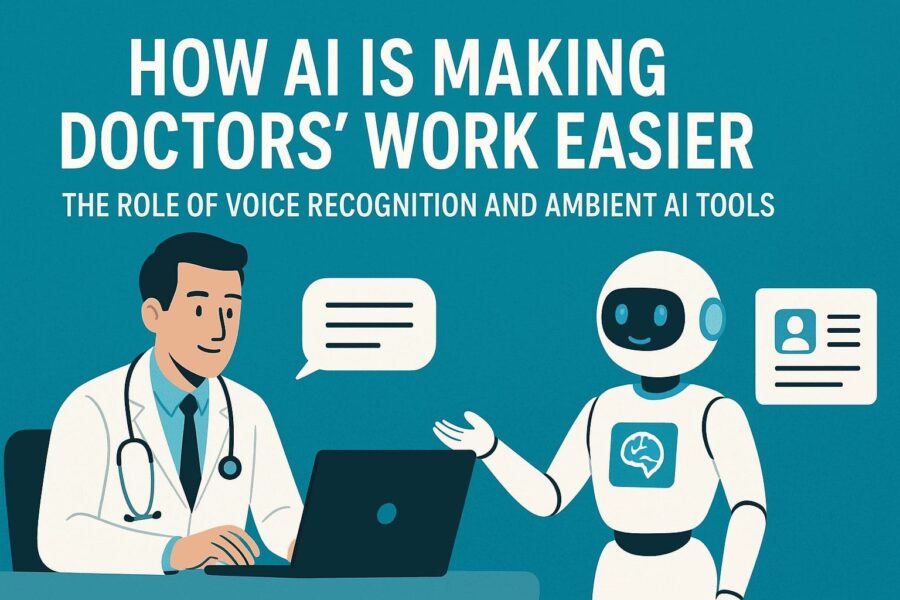
The healthcare industry is changing rapidly, and technology is playing a central role in this transformation. Every doctor knows that apart from treating patients, a large amount of time goes into writing notes, preparing reports, and completing documentation. Because of this, many doctors feel stressed and burned out. Fortunately, AI is making doctors’ work easier by supporting them with powerful tools like voice recognition and ambient AI. These advanced technologies are not replacing doctors; instead, they are helping them save time, reduce errors, and focus more on patients.
Why Documentation Burden Is a Challenge for Doctors
In every hospital and clinic, doctors are required to record medical histories, write prescriptions, and prepare discharge summaries. This administrative work often takes away precious hours that could be spent on patient interaction. Therefore, the introduction of tools that simplify documentation has become a game-changer. AI is making doctors’ work easier by handling the repetitive tasks that once consumed valuable time.
The Role of Voice Recognition Technology in Healthcare
Voice recognition technology is one of the most practical applications of AI in healthcare. With this tool, doctors can simply speak, and their words are automatically converted into written notes.
- First, voice recognition tools understand complex medical terms with high accuracy.
- Second, these tools save time as there is no need to type or write manually.
- Third, they reduce the chances of errors because modern AI models are trained to recognize medical vocabulary correctly.
Consequently, AI is making doctors’ work easier by removing the need for constant manual typing.
How Ambient AI Works for Doctors
While voice recognition focuses on dictation, ambient AI works silently in the background. During a consultation, the tool listens to the conversation between doctor and patient. Then it automatically prepares structured medical notes.
- It organizes data into history, examination, and treatment plans.
- It allows doctors to remain fully present with the patient.
- It reduces stress because the documentation happens automatically.
In this way, AI is making doctors’ work easier by performing administrative tasks without interrupting the natural flow of patient care.
Benefits of AI Tools for Healthcare Professionals
The impact of AI on healthcare is already visible in many hospitals. Some of the main benefits include:
- More Time for Patients – Doctors spend less time typing and more time listening.
- Less Burnout – By reducing workload, AI lowers stress and fatigue.
- Better Accuracy – Automated notes are consistent and clear.
- Improved Patient Satisfaction – Patients feel heard and valued when doctors are not distracted by paperwork.
- Higher Productivity – Clinics and hospitals can manage more patients efficiently.
Clearly, AI is making doctors’ work easier and creating a better healthcare system.
Real-World Examples of AI in Healthcare
Globally, several hospitals are already using ambient AI and voice recognition. In the United States, tools like Nuance DAX and Augmedix are widely used. These tools automatically prepare SOAP notes (Subjective, Objective, Assessment, Plan) after a consultation. In India, telehealth startups are adopting similar technologies to support doctors in both cities and rural areas.
With these tools, AI is making doctors’ work easier and improving the quality of care for patients worldwide.
Challenges of AI in Healthcare
Although the benefits are clear, there are some challenges.
- Data privacy and patient consent remain critical.
- Doctors need proper training to use these tools effectively.
- Some hospitals may find the initial setup cost high.
- In rural areas, digital adoption is still limited.
Even with these challenges, AI is making doctors’ work easier and helping the medical field move forward.
The Future of AI in Healthcare
The future of AI in healthcare looks promising. Experts believe that within the next decade, ambient AI tools will become a standard part of every clinic. Voice recognition will continue to improve in accuracy, and integration with electronic medical records will make workflows seamless. Because of these advancements, AI is making doctors’ work easier and changing the way healthcare systems function.
Conclusion
It is clear that AI is making doctors’ work easier by reducing the burden of documentation and administration. Voice recognition tools help doctors speak naturally while their notes are prepared instantly. Ambient AI tools silently listen and create structured medical records. Both technologies allow doctors to focus more on patients, improve accuracy, and reduce stress.
Therefore, the adoption of these tools is not just about convenience—it is about creating a more human-centered healthcare system. AI is making doctors’ work easier today, and it will continue to play an even bigger role in the future.
FAQs
Q1. How is AI making doctors’ work easier in daily practice?
AI is making doctors’ work easier by automating documentation, reducing errors, and allowing doctors to spend more time with patients.
Q2. What is ambient AI in healthcare?
Ambient AI listens in the background during consultations and automatically prepares medical notes.
Q3. Are voice recognition tools accurate for medical use?
Yes. Modern AI voice recognition systems are trained in medical vocabulary and can achieve more than 95% accuracy.
Q4. Will AI replace doctors in the future?
No. AI is making doctors’ work easier, but it cannot replace the human empathy and decision-making skills that only doctors provide.
Q5. Are these AI tools available in India?
Yes. Some telehealth platforms and hospitals have already started using AI-based voice and ambient tools in India.